
Your surgery went well. The surgeon is happy with the result. So what happens if you skip the physical therapy part?
The answer isn’t subtle. Post-operative rehabilitation therapy is not optional follow-up care; it’s the mechanism by which surgical results actually become functional ones. Without it, the tissue your surgeon repaired begins to heal in patterns your body was never designed for. This article breaks down exactly what those patterns are, why they happen, which surgeries carry the highest risk, and what patients across Houston from Sugar Land to River Oaks can do to protect their outcome.
What Actually Happens to Your Body When You Stop Moving After Surgery
Surgery fixes the structural problem. It doesn’t fix what comes next.
Within 24 to 48 hours of surgical inactivity, muscle inhibition begins not just weakness, but a neurological process where the nervous system actively suppresses muscle activation as a protective response to trauma. This is distinct from simple disuse atrophy. The muscles aren’t just idle; they’re being held back. Research published in the American Journal of Sports Medicine found that this neural inhibition is a primary driver of post-surgical strength deficits, separate from any visible muscle loss, and that targeted neuromuscular re-education restores normal activation patterns three to four weeks faster than traditional strengthening exercises alone.
The atrophy itself follows quickly. Studies on post-surgical immobilization document losses of 3 to 5% of muscle strength per day during the first week of inactivity. For knee and shoulder surgeries specifically, quadriceps muscles can shrink 10 to 20% after knee procedures, and shoulder musculature atrophies significantly after rotator cuff repair. That’s not a number that recovers on its own with rest.
The second process happening simultaneously is scar tissue formation. Your body lays down scar tissue whether you move or not. The difference is that guided movement shapes that scar tissue into functional tissue, while complete rest allows it to form indiscriminately across joint spaces, between tissue planes, and in orientations that restrict motion permanently. Once established, this condition is called arthrofibrosis, and treating it often requires a second procedure.
The second process happening simultaneously is scar tissue formation. Your body lays down scar tissue whether you move or not. The difference is that guided movement shapes that scar tissue into functional tissue, while complete rest allows it to form indiscriminately across joint spaces, between tissue planes, and in orientations that restrict motion permanently. Once established, this condition is called arthrofibrosis, and treating it often requires a second procedure.
The Six Consequences of Skipping Post-Op Rehabilitation
1. Permanent Range-of-Motion Loss
Scar tissue formation without guided loading creates joint adhesions that don’t respond to stretching later. A joint capsule that tightens in the first four weeks can remain restricted long-term, and no amount of aggressive stretching six months post-surgery will undo what early mobilization would have prevented. This is especially true for shoulder and knee surgeries where the joint capsule is directly involved in the surgical repair
2. Arthrofibrosis and the Surgery That Follows It
Arthrofibrosis after total knee replacement affects between 1 and 20% of patients who don’t receive adequate early rehabilitation, according to published orthopedic outcome data. Revision surgery for arthrofibrosis carries a 28.2% complication rate and a 17.4% reoperation rate. Patients who undergo structured post-surgical rehabilitation with early mobilization have a significantly lower incidence of this outcome in one study group using a six-month protocol, the incidence was zero.
3. Chronic Weakness and Joint Instability
Muscles weakened by surgical inhibition don’t simply recover with time. Without progressive loading under clinical supervision, the surrounding musculature stays in a partially inhibited state, and the joint it’s meant to stabilize becomes mechanically unreliable. This is why patients who skip PT after ACL reconstruction are at higher risk for re-injury not because the graft failed, but because the neuromuscular system that was supposed to protect it was never fully retrained.
4. Compensatory Movement Patterns
This one gets overlooked. Your body finds workarounds fast. When one structure is weak or painful, you shift load to adjacent muscles and joints. The problem is that these compensatory patterns become habits, and habits persist long after the original pain resolves. A patient who favors their left leg after a right knee surgery can end up with left hip pain six months later, not from any injury, but from the compensatory loading pattern that PT would have caught and corrected in week two.
5. Extended Recovery Timeline
Rest is not the same as recovery. Patients who skip post-op PT don’t recover faster; they recover slower, and often less completely. The first two weeks after surgery are when the rehabilitation window is most efficient; tissue is still responding to the surgical event, swelling management is possible, and early range-of-motion work prevents the adhesion patterns that become fixed problems later. Missing that window doesn’t just delay recovery. For some patients, it changes the ceiling of what recovery looks like.
6. Re-Injury Risk
Returning to activity without restoring strength, proprioception, and movement patterns is a straightforward path back to injury. This applies equally whether you’re an athlete returning to sport after an ACL reconstruction or a 60-year-old returning to yard work after a hip replacement. The surgery repaired the anatomy. Post-surgical physical therapy restores the function, and function is what protects you from injuring it again.
Surgery-Specific Risks: What Skipping PT Looks Like for Each Procedure
ACL Reconstruction
The graft is structurally sound at the time of surgery. The problem is the quadriceps, which can lose 10 to 20% of their mass in the first weeks of inactivity, and the proprioceptive system, which is disrupted by the surgical trauma and must be retrained. Patients who complete structured post-surgical physical therapy return to sport with significantly better neuromuscular control than those who self-manage. Those who skip PT show higher rates of re-injury not because the ACL failed, but because the system around it was never rebuilt.
Rotator Cuff Repair
Shoulder surgery creates an extended period of immobilization to allow the tendon to reattach. That immobilization, without guided progressive mobilization, is exactly the environment in which a frozen shoulder (adhesive capsulitis) develops. Range-of-motion loss after rotator cuff repair that isn’t addressed in the first four to six weeks can become a chronic, separate condition requiring its own treatment. In practice, many patients who skip PT end up treating two problems instead of one.
Hip Replacement
The risk here is gait compensation. The hip abductors, the muscles that stabilize your pelvis when you walk, atrophy rapidly after surgery. Without targeted rehabilitation, the body compensates with a Trendelenburg gait pattern (the pelvis dropping on the opposite side with each step), which transfers load to the lumbar spine, the opposite hip, and the knee. Patients in the Sugar Land and Fort Bend County area who’ve had hip replacements and haven’t started PT are frequently referred to Revolve Physical Therapy’s Sugar Land location presenting with secondary low back pain that is, at root, an unaddressed post-surgical gait problem.
Spinal Surgery (Fusion, Discectomy, Laminectomy)
Spine surgery fixes a structural problem, but the spine depends on its surrounding musculature for stability in a way no other joint does. Skip PT after a spinal fusion and the muscles that are supposed to protect that fusion, the multifidus, the transverse abdominis, the deep stabilizers remain inhibited and deconditioned. The result is added mechanical stress on the healing fusion site, increased re-injury risk, and frequently, the kind of chronic instability that leads patients to wonder whether their surgery even worked.
If You’re Already Post-Op and Haven’t Started PT, Is It Too Late?
It’s not too late, but timing still matters.
The earlier you start, the more you prevent. If you’re past the two-week window, you’re now managing scar tissue that has already begun to organize rather than preventing it from forming in problematic ways. That changes the approach but doesn’t eliminate the value of rehabilitation. The clinical priority shifts from prevention to mobilization, progressive loading, and neuromuscular retraining.
If you had surgery in the last few months and haven’t started PT yet, whether that’s because of scheduling, cost concerns, transportation issues across Houston’s sprawl, or a surgeon who didn’t emphasize it, the second-best time to start is now. Patients seen at our River Oaks, Memorial, East Downtown, and Sugar Land locations regularly begin post-operative rehabilitation therapy weeks or months after surgery, and they still achieve meaningful functional improvements.
Call 832-831-4188 to speak with a physical therapist about where you are in your recovery and what’s still possible.
What Post-Op Rehabilitation Therapy Actually Involves
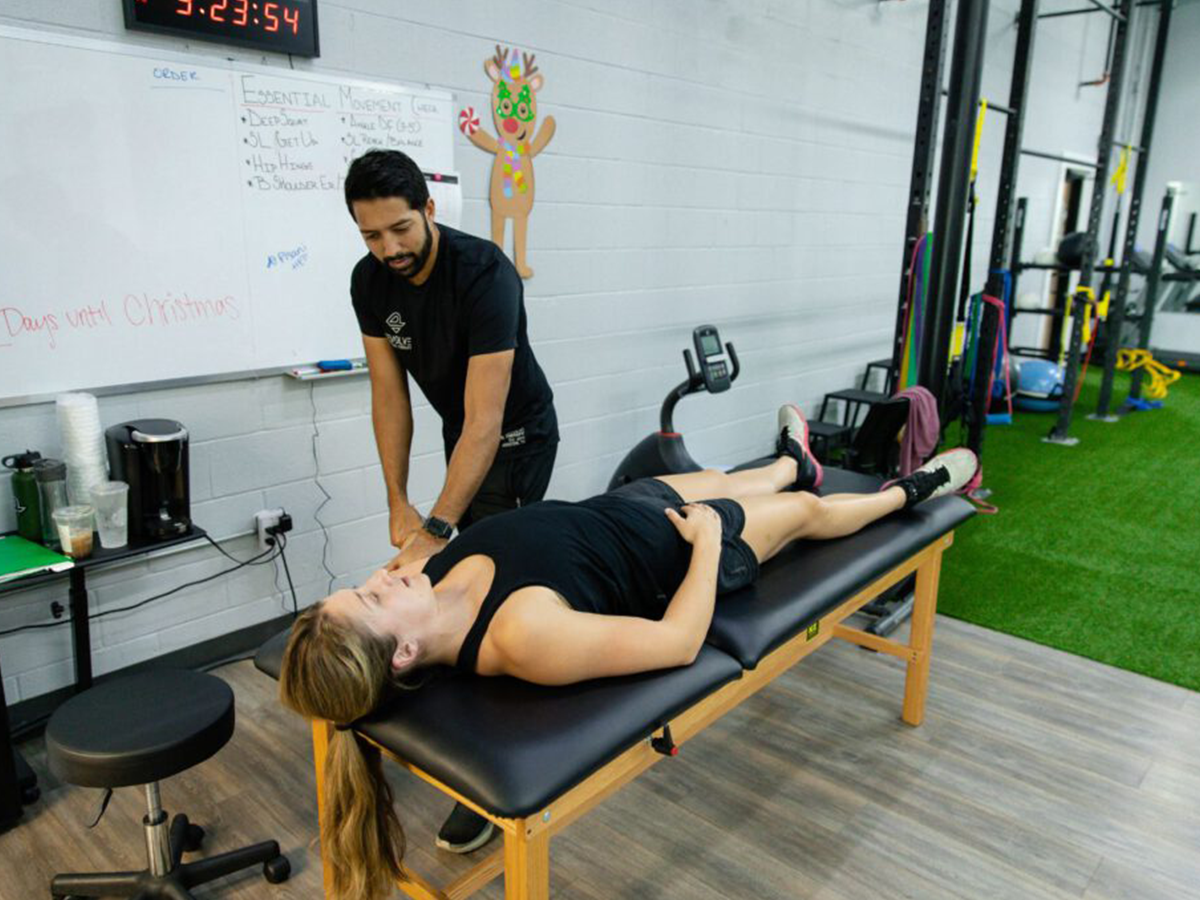
It’s not just exercises. Structured post-surgical rehabilitation covers:
- Swelling and pain management in the early phase (manual therapy, compression, appropriate loading)
- Range-of-motion restoration through progressive, supervised mobilization
- Neuromuscular re-education: retraining the nervous system’s connection to the muscle
- Strength rebuilding in the correct sequence, protecting the surgical repair while loading adjacent structures
- Gait and movement pattern correction to prevent compensatory injuries
- Return-to-activity criteria: objective tests that tell you when you’re actually ready, not just when it feels okay
The difference between a good outcome and a poor one is often not the surgery itself. It’s the quality and consistency of what comes after.
Post-Op PT in Houston: What to Know About Your Location
Houston’s geography matters for recovery compliance. A patient in Katy who is assigned to a PT clinic inside the loop isn’t going to keep every appointment. At Revolve Physical Therapy, our four Houston-area locations are positioned to serve patients across the metro without making rehabilitation another logistical problem.
- River Oaks / Upper Kirby patients View location
- Memorial / Spring Branch / Katy corridor View location
- East Downtown / Midtown View location
- Sugar Land / Fort Bend County View location
Each location runs the same evidence-based pre/post-operative care program, coordinated with your surgeon’s protocol.